A Choir Behind the Orchestra or in Front? How Placement Changes the Sound
Choir placement changes how voices blend with an orchestra and how clearly words carry. Learn to hear the effect of position, score and hall.
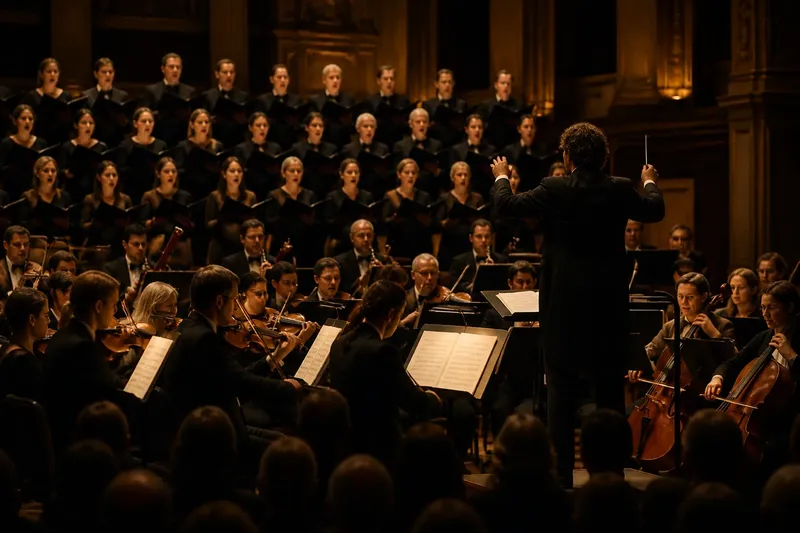
At a concert, the choir may stand on risers behind the orchestra or in a line at its front. That choir placement changes how the voices blend with instruments and how clearly words reach the audience. The seating plan offers a clue, but the score and the hall shape what listeners actually hear.
What does choir placement change?
Sound reaches each seat through a mix of direct sound and reflections from the stage, walls and ceiling. A choir behind the orchestra may seem woven into the instrumental texture; singers at the front may feel more immediate and distinct. Neither impression is automatic. Stage height, orchestral balance and the listener’s position all contribute.
The visible layout is not a dependable verdict on clarity. Singers behind the players are not necessarily buried, and singers at the front do not automatically make every word intelligible. The more useful question is how the relationship changes as the music changes.
Why place a choir behind the orchestra?
Positioning the choir behind the players can help voices feel part of a broad musical landscape. This may suit writing in which the chorus joins the orchestral sound rather than sitting apart from it. When the accompaniment leaves room, the voices can blend while their words remain audible.
The trade-off appears when the orchestral texture grows dense. Instruments between the audience and singers can soften consonants, even if the choir’s sustained vowels remain present. A restrained accompaniment gives diction more room than a busy one, so the same placement can sound clear in one passage and less distinct in another.
What changes when singers stand in front?
A choir at the front may bring diction and vocal detail closer to the audience. That can help when the text carries the dramatic point or when a choral entrance needs to register clearly. But the voices may also sound like a separate layer in front of the orchestra, rather than part of a shared sonority.
Forward placement does not simply make singers louder. The angle of the seats, the arrangement of the stage and the hall’s reflections all affect the result. Listen for whether the voices sit convincingly with the instruments, not just whether they seem prominent.
How do the score and hall shape the result?
The score gives placement its purpose. Some passages ask voices to merge into the orchestral colour; others rely on crisp words or a distinct choral line. Conductor, singers and orchestra shape that balance through dynamics and articulation, while risers can help singers project over the players.
Hall acoustics complicate any simple front-or-back rule. Reflections can reinforce a voice or blur its edges, and a choir may carry clearly in one area while sounding less distinct elsewhere. A central seat can offer a coherent impression of the whole ensemble, though it cannot reveal every detail heard from the sides or rear.
Imagine a choir behind the orchestra during a passage with a clear vocal phrase and a quiet accompaniment. The words may remain understandable while the voices blend with the instruments. When the orchestra grows fuller, the text may soften; that shift points to the changing texture as well as the choir’s position.
What do listeners often want to know?
Does a choir behind the orchestra always sound distant?
No. Stage height, orchestral balance, the hall and the listener’s seat all affect the impression of distance. Singers can remain clear behind the players when the music leaves space for their sound.
Does a front position always improve diction?
It may make words feel more immediate, but clarity also depends on articulation and accompaniment. A forward position can separate the choir from the orchestral texture without making every word easy to follow.
Which placement helps voices blend with instruments?
A position behind the orchestra may encourage a unified sound, but it does not create one by itself. The score, dynamics, spacing and acoustics can matter as much as the broad choice of front or back.
Where can I hear the balance most clearly?
A central seat often gives a useful impression of the combined forces, but no single location reveals every part equally. Compare a lighter passage with a fuller one to hear how the choir’s clarity shifts with the orchestral texture.
What should you listen for during a performance?
Follow the choir through a change in texture. Does it emerge when the accompaniment thins, then blend back into the ensemble as the orchestra fills out? That movement may tell you more than the seating plan alone. It is not worth trying to infer the conductor’s whole intention from stage layout: practical constraints can shape the arrangement too.
Choir placement is a useful way to think about the changing balance between words, voices and instruments, not a contest with one winning position. At the next concert, notice whether the choir’s diction holds as the texture thickens, and whether the voices still feel connected to the orchestra when they come forward in the sound.